


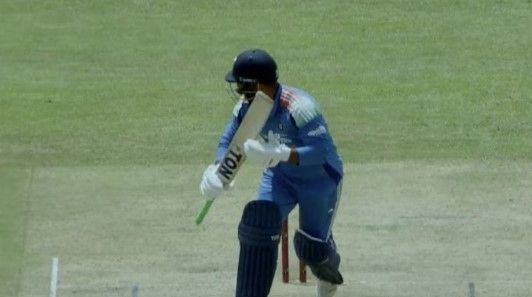
India A was penalized 10 runs during a Tri-Nation A Series match against Sri Lanka A in Dambulla due to a rare breakdown in team discipline. The penalty stems from MCC Law 41.14, which forbids batters from causing avoidable damage to the "protected area" of the pitch. This critical zone, the central strip running down the middle of the pitch, must stay flat and undisturbed to ensure fair play for both teams.
Because cricket players wear sharp metal spikes on their shoes, running directly on the grass ruins the surface, creating rough footprints that give spinners an unfair advantage later in the game.The initial trouble started when No. 8 batter Anukul Roy ran carelessly down the middle of the pitch. On-field umpires Prageeth Rambukwella and Shantha Fonseka stopped play to issue an official, formal warning to the entire India A squad.
Even though Roy was out a couple of overs later, cricket laws dictate that a team warning stays active for the remainder of the innings. Any further mistake from any player would trigger automatic penalties. All-rounder Vipraj Nigam walked in at No. 9. During the 35th over, Nigam completed a standard single but ran directly through the center of the pitch. The umpires immediately declared a dead ball, halted the game, and awarded Sri Lanka A their first five penalty runs.
Just two overs later, Nigam faced spinner Kugathas Mathulan and guided a shot toward the short third-man fielder. In a moment of panic, Nigam charged forward for a quick single. His batting partner, Suryansh Shedge, yelled for him to go back. As Nigam frantically spun around to slide back into his crease, he completely forgot his positioning and ran straight over the protected area for a second time. The umpires stopped play again and tacked on another five-run penalty.
Suryansh Shedge scores 72 in 66 balls against Sri Lanka A in Tri- Nation series
Suryansh Shedge played a true saviour's innings, smashing 72 runs off 66 balls under intense pressure. His masterclass at the Rangiri Dambulla International Stadium single-handedly transformed India A's fortunes when all hope seemed lost. India A chose to bat first but suffered a horrific top-and-middle-order collapse on a tricky pitch.
Established stars like Ruturaj Gaikwad (37) and captain Tilak Varma (23) fell early. From a reasonable position, India A crumbled rapidly to a disastrous 143 for 7.When Shedge walked out at Number 7, India A was in danger of being bowled out for under 180. Shedge did not just survive; he completely dictated the game with all-rounder Vipraj Nigam (51 runs off 49 balls). Together, they put up a phenomenal 104-run partnership for the 8th wicket.
Shedge spent his first 20 balls rotating the strike and picking up singles to calm the dressing room. Once settled, he began targeting the boundaries. His 72-run knock featured 3 crisp fours and 2 towering sixes, maintaining an impressive strike rate of 109.09. This marked Shedge's first-ever List-A half-century, proving his pedigree in the 50-over format. Shedge was the final Indian wicket to fall, and his exit sparked a major debate.
Attempting a big shot off bowler Mohamed Shiraz, he lofted the ball deep to the long-on fence. Fielder Ahan Wickramasinghe caught the ball right on the edge of the rope.TV replays strongly hinted that Wickramasinghe’s boot may have brushed the boundary rope while he was holding the ball. Shedge stood his ground, expecting a six to be signaled, but after multiple slow-motion angles, the third umpire controversially ruled him out. India A finished at 265 all out.