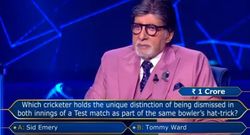


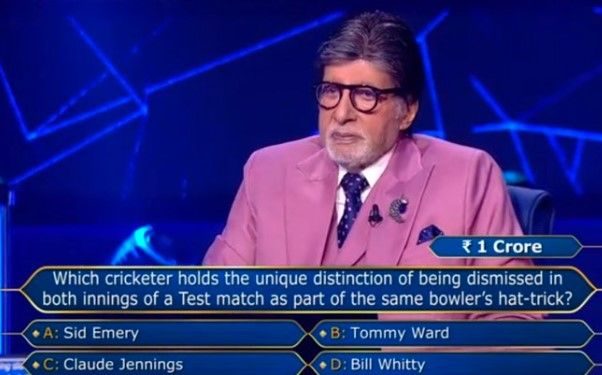
More than a hundred years after it happened, a little known cricket record from 1912 became the ₹1-crore question on Kaun Banega Crorepati. Mumbai-based SSC aspirant Ruchita Adhalrao was the contestant who was asked the question. “Which cricketer holds the rare distinction of being dismissed in both innings of a Test match as part of the same bowler’s hat-trick?” The options were Sid Emery, Tommy Ward, Claude Jennings and Bill Whitty. Ruchita decided to quit rather than guess the answer. When host Amitabh Bachchan asked her to guess after quitting she chose Claude Jennings. The correct answer was Tommy Ward.
The story behind the record is as unusual as the question itself. On 28 May 1912, at Old Trafford in Manchester, Australia faced South Africa in the opening Test of the Triangular Tournament. Australian leg-spinner Jimmy Matthews produced something that has never been repeated in Test cricket. He took a hat-trick in each innings of the same match, both on the same day. In South Africa’s first innings, Matthews claimed the last three wickets. The third of them was debutant wicketkeeper Tommy Ward, who was trapped lbw for a golden duck. South Africa were forced to follow on. Later that afternoon, Matthews struck again.
He dismissed two batsmen in successive deliveries and once more had Ward as his third victim this time caught and bowled. Ward walked back for another golden duck, completing a king pair on his Test debut.
Who was Thomas Ward? South Africa’s Wicketkeeper From 1912 to 1924
Thomas Alfred Ward settled in South Africa and became a wicketkeeper for Transvaal in first-class cricket from 1909 to 1926. A good gloveman and a useful lower-order batsman, he was selected for South Africa’s tour of England in 1912 for the unique Triangular Tournament involving England, Australia and South Africa. His Test debut came on 27 May 1912 against Australia at Old Trafford, Manchester. He had recorded a king pair (two first-ball ducks) on debut, and Matthews had achieved the only instance in Test history of taking a hat-trick in both innings of the same match. All six wickets in those two hat-tricks came without any fielder’s assistance. This remains the sole occasion in Test cricket where a batsman has been dismissed as the third victim of the same bowler’s hat-trick in both innings of one game. No one has repeated Matthews’ double hat-trick either.
Despite that disastrous start, Ward went on to play 23 Tests for South Africa between 1912 and 1924. He scored 459 runs at an average of 13.90, with a highest score of 64 (when he opened the batting against England in 1922–23). He also made a fifty as an opener on the 1924 tour of England. Behind the stumps he was good, taking 19 catches and effecting 13 stumpings. In first-class cricket he played 92 matches, scoring 1,635 runs with a top score of 75. Ward toured England twice (1912 and 1924). He died on 16 February 1936 at the age of 48 after being accidentally electrocuted while working at a gold mine in Transvaal.