


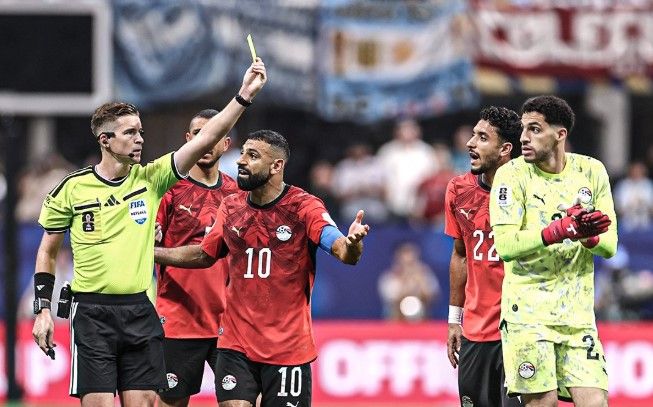
The Egyptian Football Association (EFA) officially requested that FIFA launch a formal investigation into French referee François Letexier and his VAR crew, demanding their immediate removal from the remainder of the 2026 World Cup. Despite the furious backlash from Egyptian fans, players, and coaching staff, there is a zero per cent chance of a replay or rematch. Under FIFA's official competition regulations and the International Football Association Board (IFAB) Laws of the Game, match results are legally final the moment the referee blows the final whistle.
Egypt shocked the world champions by taking a 1-0 lead in the first half via a Yasser Ibrahim goal. In the 58th minute, with Egypt still dominating, Mostafa Ziko scored what seemed to be a definitive 2-0 cushion. It was violently struck down by VAR. Despite Ziko later finding a legitimate second goal to make it 2-0 in the 67th minute, Egypt completely collapsed late in the game. Argentina scored three unanswered goals in just 13 minutes (Cristian Romero 78', Lionel Messi 82', and Enzo Fernández 90+2') to stage a historic 3-2 comeback.
The Egyptian Football Association (EFA) disputed VAR decisions and officiated in their 3-2 loss to Argentina, focusing on a disallowed 58th-minute goal and a denied 93rd-minute penalty for Mohamed Salah. While the EFA argued the disallowed goal ruined momentum, VAR intervention was justified under the Attacking Phase of Play (APP) rule, which identified a foul during the initial possession. Furthermore, FIFA deemed the disallowed penalty a subjective physical duel, and attributed the disciplinary imbalance to late-match dissent rather than unfair targeting, concluding no "clear and obvious error" occurred.
Why FIFA regulations rule out World Cup replay between Argentina and Egypt?
Under FIFA's official regulations and IFAB guidelines, a match rematch is legally impossible because refereeing decisions are final, governed strictly by Law 5 of the Laws of the Game. This foundational statute dictates that all on-field judgments regarding facts connected with play, including disallowed goals, fouls, and penalties, cannot be modified retroactively once the final whistle blows, even if subsequent video reviews expose an error.
FIFA’s disciplinary framework limits match replays exclusively to technical misapplications of the law or severe administrative malpractice by match officials. A technical error occurs only when a referee violates an objective rule, such as failing to send off a player who received two yellow cards, or allowing a twelfth player on the pitch.
Subjective interpretations of physical duels, missed fouls, or controversial Video Assistant Referee (VAR) reviews are classified as human judgment calls, not systemic rule violations, and explicitly do not qualify for replays under the tournament code. Furthermore, historical precedents of ordered replays, such as the 2021 Brazil vs. Argentina qualifier, are legally distinct from this scenario.
Those specific matches were prematurely abandoned or left incomplete due to external force majeure or regulatory interventions. Since Argentina vs. Egypt Round of 16 fixture was successfully played to its full 90-minute regulatory conclusion without abandonment, the final result is legally binding. The Egyptian Football Association’s (EFA) formal complaint will only result in internal referee performance reviews, but the on-field sporting verdict remains completely unalterable.